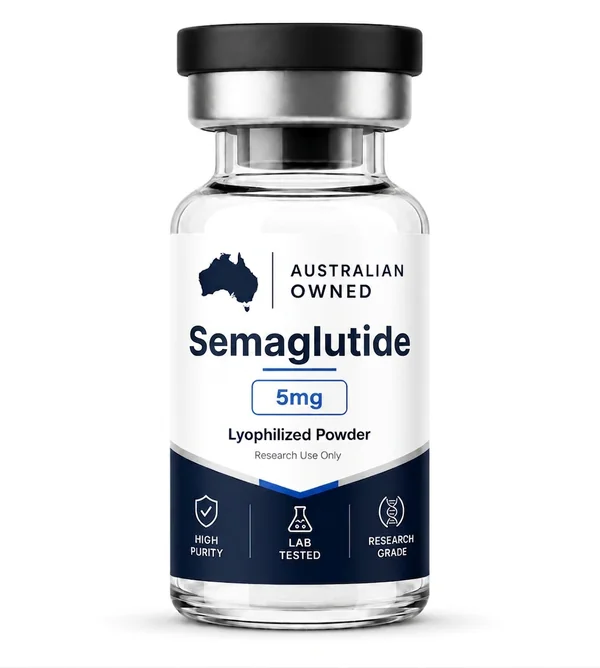
A deep dive into the chemical architecture and pharmacodynamic properties of semaglutide, providing Australian investigators with essential data on purity and benchtop stability.
The development of semaglutide marked a pivotal shift in the study of incretin mimetics. By modifying the primary structure of human GLP-1, scientists created a molecule capable of significantly resisting enzymatic degradation. This was achieved through the substitution of alanine with alpha-aminoisobutyric acid at the second position, coupled with the addition of a C18 fatty acid chain. This specific molecular engineering allows the peptide to bind reversibly to albumin, extending its biological presence in test subjects far beyond that of its natural counterparts.
In the Australian scientific community, semaglutide is frequently utilized as a baseline for examining endocrine signaling and metabolic regulation. To ensure that experimental outcomes are valid and reproducible, researchers must prioritize the chemical integrity and structural consistency of the peptide lots used in their trials.
Pharmacodynamic Actions at the GLP-1 Receptor
Semaglutide functions by selectively targeting the GLP-1 receptor (GLP-1R), a member of the secretin receptor family. Upon binding, it initiates the intracellular production of cyclic adenosine monophosphate (cAMP), which acts as a secondary messenger for various metabolic responses. In laboratory settings, this pathway is often monitored to observe how synthetic peptides influence cellular energy balance and glucose-dependent insulin secretion.
While literature provides a roadmap for expected receptor affinity, the actual performance of semaglutide in an in vitro or in vivo model is entirely dependent on the absence of contaminants. Impurities or truncated sequences resulting from poor synthesis can significantly alter binding kinetics, leading to skewed data that misrepresents the peptide's true potential.
Verify Your Research Calculations
Utilise our high-precision tool to determine the exact liquid ratios for your semaglutide vials.
Inventory Checklist for Analytical Quality
- HPLC Verification: Ensure the peptide exhibits a single, sharp peak indicating high purity (typically >98%).
- Mass Spectrometry: Confirm the molecular mass aligns exactly with the theoretical weight of semaglutide.
- Lyophilisation State: Check that the 'cake' is uniform and free from moisture, which indicates stable vacuum sealing.
- Thermal History: Verify the cold-chain logistics from the Australian warehouse to your facility.
Quality Control Parameters
| Assessment Type | Target Metric | Significance |
|---|---|---|
| Chromatographic Purity | ≥ 98% | Reduces variables from non-target sequences |
| Solubility | Complete | Ensures accurate concentration for dosing |
| Sterility Testing | Negative | Prevents microbial interference in cultures |
Preparation and Reconstitution Methodology
To maintain the delicate tertiary structure of semaglutide, reconstitution should be performed with extreme care. Mechanical stress, such as vigorous shaking, can cause the peptide to denature or aggregate, rendering the solution ineffective for precise scientific measurement.
- Warm the lyophilised vial to room temperature before removing the seal.
- Cleanse the rubber stopper with medical-grade isopropyl alcohol.
- Inject bacteriostatic water slowly, allowing the liquid to run down the side of the vial.
- Gently rotate the vial in a slow, circular motion until the solution is entirely clear.
- Label the vial with the concentration, date, and technician's name.
- Store immediately in a fridge between 2°C and 8°C.
Order High-Purity Semaglutide
Secure reference-standard semaglutide from our Australian inventory for your next study.
Guidelines for Long-Term Storage
Peptide stability is highly sensitive to environmental factors. For extended storage of unmixed powders, temperatures of -20°C are recommended. Once reconstituted, the liquid semaglutide should be utilized within a 6-week window for optimal activity. Researchers should avoid multiple freeze-thaw cycles; if the study requires smaller doses over a long duration, the solution should be aliquoted into sterile containers before the initial freeze.
Research FAQ
Why is semaglutide considered more stable than natural GLP-1?
The inclusion of a fatty acid side chain and specific amino acid substitutions protects the peptide from rapid breakdown by the enzyme DPP-4, allowing for a much longer half-life in research models.
Can I request the specific HPLC data for my order?
Yes, every batch at Buy Peptides is independently tested. You can find these reports in our COA library or request them via our support team.
What happens if the solution appears cloudy after mixing?
Cloudiness or visible particles indicate that the peptide has either failed to dissolve or has aggregated. In such cases, the solution should not be used for experimental purposes as the concentration will be inaccurate.
What is the primary role of semaglutide in metabolic studies?
It is predominantly used to investigate the mechanisms of glucose regulation, appetite suppression signals in the brain, and the protective effects of GLP-1 agonists on various organ systems.
Technical Assistance and Batch Support
Need help with shipping times or payment methods? Our Australian team is here to assist.