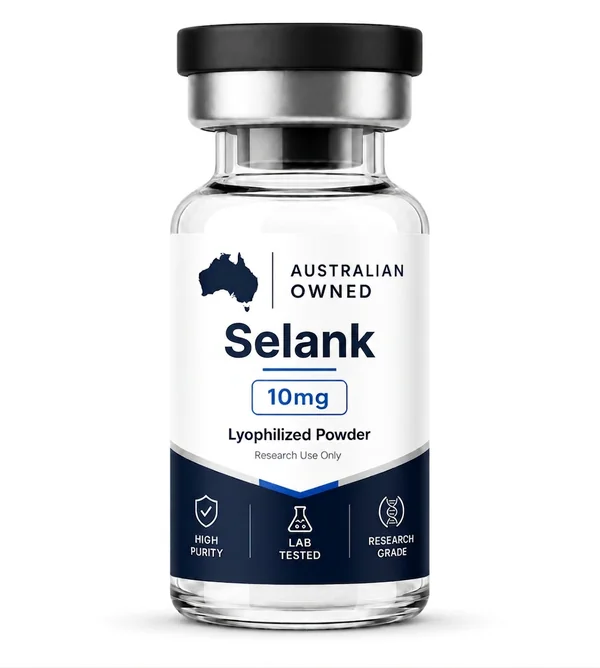
A deep dive into the biochemical properties of selank peptide, examining its tuftsin-based structure, enzymatic resilience, and the rigorous analytical standards required for domestic research.
In the landscape of Australian neurochemical inquiry, selank peptide remains a focal point for studies involving synthetic analogues of naturally occurring immunomodulatory sequences. This heptapeptide, engineered to mimic the activity of tuftsin while possessing enhanced metabolic stability, requires precise handling to ensure experimental data remains valid and reproducible across laboratory settings.
Molecular Properties and Structural Integrity
Selank peptide is distinguished by its unique Thr-Lys-Pro-Arg-Pro-Gly-Pro sequence. The addition of the Pro-Gly-Pro tripeptide to the C-terminus is not merely structural; it is a strategic modification intended to protect the molecule from rapid degradation by plasma peptidases. In a research context, this increased half-life allows for more sustained observations of its interaction with neurotransmitter systems compared to its endogenous counterparts.
Analytical Verification Benchmarks
For Australian institutions, the primary challenge in sourcing selank peptide involves ensuring chemical purity. Impurities introduced during solid-phase synthesis can interfere with receptor binding assays or cell signalling studies. Consequently, verifying the absence of truncated sequences and ensuring a purity level of 98% or higher is a fundamental requirement for high-impact research.
Verify Batch Specifications
Confirm the molecular weight and purity of your specific lot before beginning your study.
Storage and Stability Protocols
Maintaining the bioactivity of selank peptide depends heavily on adhering to cold-chain logistics. Exposure to thermal fluctuations or UV light can lead to peptide bond hydrolysis, rendering the material unsuitable for quantitative analysis.
- Lyophilised powders must be kept in a freezer at -20°C for long-term preservation.
- Ensure the storage environment is desiccated to prevent moisture-induced degradation.
- Reconstituted solutions should be stored in a narrow temperature window of 2°C to 8°C.
- Limit the number of freeze-thaw cycles by aliquoting the peptide immediately after hydration.
Reconstitution Parameters for In Vitro Use
| Step | Action Required | Scientific Rationale |
|---|---|---|
| Acclimatisation | Warm vial to room temperature | Prevents condensation and moisture contamination |
| Diluent Addition | Slow injection of bacteriostatic water | Minimises mechanical stress and peptide foaming |
| Dissolution | Gentle swirling (no shaking) | Protects the secondary structure of the peptide chain |
| Labelling | Note concentration and date | Ensures accurate dosage and tracks stability window |
Acquire Research Grade Peptides
Source high-purity selank peptide for your laboratory with rapid domestic shipping.
Supply Chain Reliability in Australia
Australian researchers often face delays and quality risks when importing compounds. Utilising a domestic supplier like Buy Peptides mitigates these risks by providing materials that have been stored under climate-controlled conditions and verified by local standards. This ensures that the selank peptide arriving at your facility meets the strict specifications required for rigorous peer-reviewed science.
Common Research Inquiries
What is the primary indicator of selank peptide quality?
Quality is best assessed through High-Performance Liquid Chromatography (HPLC) for purity and Mass Spectrometry (MS) to confirm the molecular identity matches the theoretical weight of the heptapeptide.
How long does the peptide remain stable once dissolved?
When reconstituted with bacteriostatic water and refrigerated at 2-8°C, selank peptide generally maintains its integrity for approximately 4 weeks.
Why is tuftsin relevant to selank research?
Selank was developed as a synthetic analogue of tuftsin; understanding tuftsin's immunomodulatory role provides the foundational context for selank’s modified metabolic stability.
Are there specific requirements for the diluent used?
Bacteriostatic water is preferred for research purposes to inhibit microbial growth, though sterile saline may be used if the experiment requires a different ionic balance.
Support and Logistics
Our team assists with institutional procurement and technical documentation.