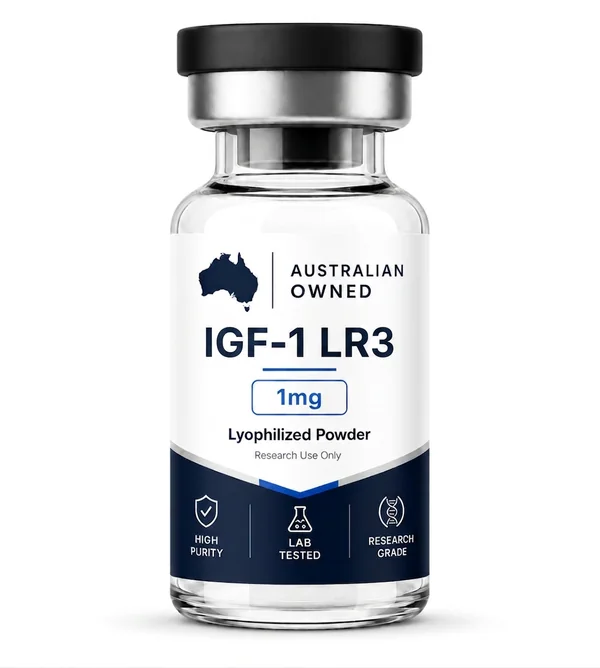
An analytical deep-dive into the biochemical profile and preservation requirements of IGF-1 LR3, focused on maintaining reagent integrity within Australian research environments.
The engineered peptide IGF-1 LR3 (Long R3 Insulin-Like Growth Factor 1) serves as a potent research tool due to its modified 83-amino acid sequence. By incorporating an arginine substitution at the third position and an additional 13-residue N-terminal extension, this analogue exhibits a significantly reduced affinity for insulin-like growth factor-binding proteins (IGFBPs). This structural deviation effectively enhances the molecule's bioavailability and extends its functional window during in vitro experimentation compared to the naturally occurring hormone.
Technical Specifications & Molecular Profile
For Australian laboratories, understanding the biochemical nuances of igf-1 lr3 is paramount for ensuring experimental reproducibility. The compound is typically supplied as a lyophilised powder to preserve the delicate tertiary structure of the recombinant protein.
| Feature | Scientific Detail |
|---|---|
| Amino Acid Count | 83 Residues |
| Primary Modification | Arg3 Substitution + N-Terminal Extension |
| Purity Benchmark | ≥ 98% via RP-HPLC |
| Storage Form | Lyophilised (Freeze-dried) Solid |
Workflow for Reagent Reception and Validation
Maintaining an unbroken chain of quality begins the moment the igf-1 lr3 arrives at the facility. Researchers should prioritise immediate documentation and visual inspection to mitigate risks of batch contamination or degradation.
- Inspect the external packaging for thermal integrity and ensure the vacuum seal of the vial is uncompromised.
- Compare the lot number on the igf-1 lr3 container with the digital batch records provided.
- Access the COA library to verify that the mass spectrometry data matches the theoretical weight of the 83-residue sequence.
- Log the arrival date and current lyophilised state (e.g., uniform white cake) into the lab’s reagent management system.
Verify Your Research Materials
Cross-reference your current batch with our comprehensive database of analytical reports.
Optimised Reconstitution and Storage Strategy
Because igf-1 lr3 is a complex protein, it is susceptible to mechanical shear and thermal denaturation. The following steps outline the standard protocol for preparing a stable solution.
- Allow the vial to reach ambient temperature to prevent condensation during the addition of diluent.
- Introduce the solvent (typically bacteriostatic water) slowly, aiming for the side of the glass to avoid turbulence.
- Gently rotate the vial in a circular motion; never agitate or shake the igf-1 lr3 solution as this can cause protein aggregation.
- Store the solubilised reagent at 2–8°C, shielded from all light sources to prevent photo-degradation.
- For long-term studies, divide the solution into single-use aliquots to prevent the degradation associated with repeated freeze-thaw cycles.
Analytical Tools for Research
Use our precision tools to calculate exact concentrations for your igf-1 lr3 assays.
Inventory Management and Procurement
Sourcing igf-1 lr3 through Buy Peptides ensures that Australian researchers receive reagents that have undergone rigorous third-party testing and climate-controlled domestic shipping. When an experimental phase nears completion, reconcile the remaining volume against the initial log to ensure precision in longitudinal data reporting.
Why is the Arg3 substitution significant in IGF-1 LR3 research?
This specific modification reduces the peptide's affinity for binding proteins, which in turn increases the availability of the free peptide for receptor interaction during laboratory studies.
What is the recommended temperature for long-term lyophilised storage?
For extended preservation of several months or years, the dry igf-1 lr3 powder should be kept in a controlled environment at -20°C.
How long does the peptide remain stable once it has been mixed?
When kept refrigerated at 2–8°C in a bacteriostatic medium, the compound typically maintains its integrity for approximately 28 to 42 days.
What should be done if the lyophilised powder appears collapsed?
A collapsed cake may indicate moisture ingress or thermal stress. You should document the appearance and contact the technical team via our support page to verify the batch viability.
Source High-Purity IGF-1 LR3
Access premium recombinant peptides with express shipping across Australia.