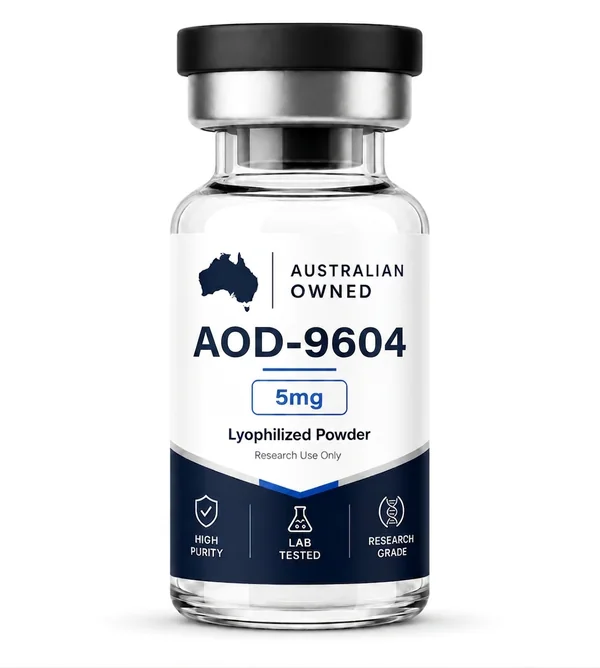
An analytical deep-dive into the peptide fragment AOD 9604, focusing on laboratory reconstitution, secondary structure preservation, and domestic procurement protocols.
The scientific community in Australia continues to investigate the specific metabolic interactions of aod 9604 peptide within controlled in vitro environments. As a modified C-terminal fragment of human growth hormone, this compound is specifically utilised to observe lipolytic signaling without the confounding growth-promoting effects associated with the full-length hormone.
For researchers to generate reliable data, the chemical precision of the reagent is paramount. Small variations in peptide synthesis can lead to significant discrepancies in assay outcomes. Therefore, understanding the rigorous standards required for domestic laboratory supply is essential for institutional compliance.
Core Biochemical Specifications of AOD 9604
Technically identified as Tyr-hGH177-191, the aod 9604 peptide is engineered to maintain high affinity for fat metabolism pathways while remaining inert regarding IGF-1 secretion. This selectivity makes it a unique tool for cellular lipid studies where researchers must isolate metabolic triggers from systemic growth signals.
| Feature | Laboratory Requirement | Impact on Research |
|---|---|---|
| Sequence Fidelity | Confirmed via Mass-Spec | Ensures accurate receptor binding |
| HPLC Purity | Min 98% Threshold | Eliminates confounding contaminants |
| Lyophilised State | Vacuum-sealed powder | Ensures long-term chemical stability |
| Appearance | Fine white lyophilised cake | Indicates successful freeze-drying |
Verification through Analytical Testing
Every batch of aod 9604 peptide must undergo High-Performance Liquid Chromatography (HPLC) to map the purity profile. This objective data allows laboratory managers to confirm that the material meets the stringent 98%+ purity benchmarks required for peer-reviewed publication.
Verify Your Batch Quality
Access our repository of analytical documentation to confirm the purity and identity of your laboratory reagents.
Reconstitution and Solution Management
Correct handling during the transition from a lyophilised solid to a liquid phase is critical to prevent peptide shearing or degradation. Adherence to sterile laboratory techniques ensures the longevity of the aod 9604 peptide solution.
- Equilibrate vials to room temperature before removing the flip-off cap.
- Use 70% isopropyl alcohol to decontaminate the rubber stopper.
- Slowly introduce bacteriostatic water (BAC) down the side of the glass wall.
- Employ a gentle swirling motion rather than shaking to achieve full solubility.
- Store the prepared solution strictly at 2–8°C to maintain structural integrity.
- Aliquoting is recommended if the entire volume will not be used within a 30-day window.
Storage Dynamics for Peptide Longevity
Environmental factors such as light, heat, and moisture are the primary drivers of peptide degradation. In its powder form, the aod 9604 peptide should be stored at -20°C for maximum shelf life. Once in solution, the peptide becomes significantly more fragile. Researchers should monitor the pH of the diluent and ensure the refrigeration unit remains stable, as repeated temperature fluctuations can lead to precipitation or loss of bioactivity.
Procure High-Purity AOD 9604
Secure Australian-stocked peptides with guaranteed purity and rapid domestic shipping.
Research Inquiry FAQ
Why is domestic Australian shipping preferred for AOD 9604?
Local dispatch prevents the peptide from being exposed to excessive heat in transit and bypasses the lengthy delays and degradation risks associated with international customs.
What is the primary indicator of aod 9604 peptide quality?
The HPLC chromatogram is the industry standard, showing a single clear peak representing the target sequence with minimal secondary peaks.
How should aod 9604 be handled for long-term storage?
Unopened vials should be kept in a freezer at -20°C. If the vial is reconstituted, it must be refrigerated and used within approximately 4 to 6 weeks.
Can I obtain a digital copy of the lab results?
Yes, we provide a searchable COA library where researchers can input batch numbers to download the relevant analytical data.
Is this peptide suitable for human therapeutic use?
No. This compound is strictly for laboratory-based scientific research and is not intended for any clinical or human application.
Ready for Laboratory Deployment?
Ensure your project utilizes the highest standard of Australian research reagents.