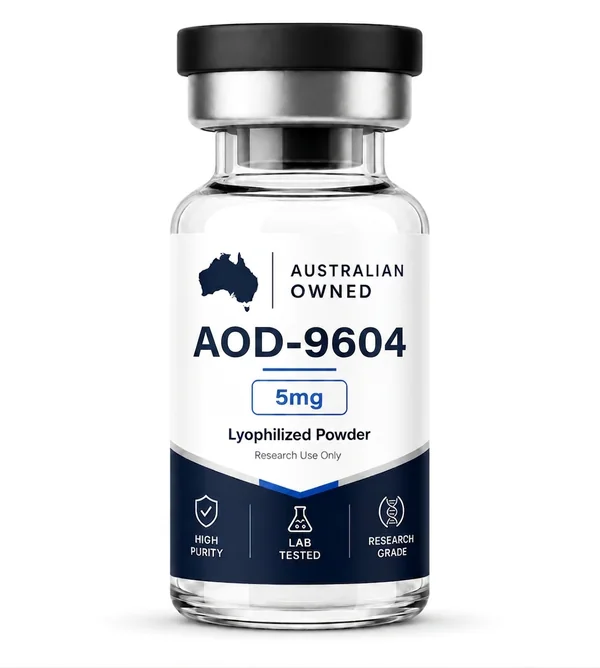
A comprehensive technical exploration of AOD-9604 within Australian research environments, focusing on biochemical stability, precise reconstitution, and data-driven storage standards.
In the landscape of Australian metabolic research, AOD-9604 continues to be a subject of intense scrutiny. This peptide, a C-terminal fragment of human growth hormone, requires rigorous handling protocols to ensure that in vitro data remains accurate and reproducible across different study phases. Understanding the delicate nature of this sequence is paramount for any laboratory operating within the domestic scientific sector.
Molecular Integrity and Initial Assessment
Upon the arrival of AOD-9604 at an Australian facility, the first priority is verifying the physical state of the lyophilised powder. Researchers must ensure the vacuum seal is intact and the peptide cake has not undergone deliquescence due to moisture ingress or thermal mismanagement during transit.
Verify Your Research Materials
Access our comprehensive library of independent laboratory audits to confirm the purity of your current batch.
Standard Laboratory Reconstitution Parameters
Precision during the transition from solid to liquid state determines the viability of the entire experiment. The following table outlines the critical control points for preparing AOD-9604 solutions:
| Parameter | Scientific Requirement | Rationale |
|---|---|---|
| Solvent Choice | Bacteriostatic Water (0.9% Benzyl Alcohol) | Inhibits microbial proliferation during multi-draw studies. |
| Temperature Gradient | Equilibrate to 20-22°C before mixing | Prevents thermal stress on the peptide peptide bonds. |
| Introduction Velocity | Slow, wall-directed stream | Minimises surface tension and prevents foaming/denaturation. |
| Agitation Method | Gentle axial rotation | Avoids mechanical shear of the amino acid sequence. |
Optimising Storage for Long-Term Data Accuracy
- Unopened vials should be archived at -20°C for maximum shelf-life stability exceeding 24 months.
- Post-reconstitution, AOD-9604 must be maintained strictly between 2°C and 8°C in a light-shielded environment.
- Avoid 'frost-free' freezers for dry storage, as temperature fluctuations can degrade the peptide's primary structure over time.
- Limit the number of times a vial is removed from cold storage to prevent condensation cycles.
Secure AOD-9604 for Your Lab
Buy Peptides provides high-purity AOD-9604 with rapid domestic shipping across Australia.
Analytical Verification: HPLC and MS Data
For Australian researchers, relying on third-party verification is non-negotiable. Every batch of AOD-9604 should be accompanied by High-Performance Liquid Chromatography (HPLC) to confirm a purity threshold of >98%. Additionally, Mass Spectrometry (MS) is utilised to verify that the molecular weight aligns perfectly with the theoretical mass of the 177-191 fragment.
Documenting Experimental Progress
Effective inventory management involves logging the date of first puncture, the volume of diluent added, and the calculated concentration in mg/mL. This ensures that every aliquot used in an assay can be traced back to its specific batch certificate, maintaining the integrity of the published results.
Technical FAQ: AOD-9604 Research
What is the molecular weight of AOD-9604 for MS verification?
Researchers should look for a molecular mass of approximately 1815.1 Da during mass spectrometry analysis to confirm the identity of the 177-191 fragment.
How does pH affect the solubility of AOD-9604?
AOD-9604 is generally stable in slightly acidic to neutral buffers. Significant deviations in pH during reconstitution can lead to precipitation or accelerated hydrolysis.
Is it possible to aliquot AOD-9604 after the initial mix?
Yes, if the research timeline exceeds 30 days, it is recommended to divide the solution into single-use sterile tubes and store at -20°C to avoid repeated freeze-thaw cycles.
What indicates that a peptide has degraded?
Signs include the presence of visible particulates in a previously clear solution, or a shift in the retention time during subsequent HPLC testing.
Professional Support for Research Facilities
Contact our technical team for assistance with institutional procurement or specific batch inquiries.